Every law firm call follows a different path, and your virtual receptionists should treat them accordingly.
A criminal defense prospect may need immediate legal attention, while a potential estate planning client may follow a much simpler qualification process. A prospective divorce client may require detailed intake and an appointment scheduled with multiple parties.
An existing client may simply need to leave a message for their attorney. Opposing counsel may need to be transferred immediately. A judge’s staff may need to reach an attorney without navigating the same process as everyone else.
Even within the same practice area, the appropriate questions and next steps can vary based on the circumstances and who is on the other end of the phone.
A one-size-fits-all intake script quickly becomes cumbersome when your firm handles multiple case types.
With Back Office Betties, call-handling logic is customized around the way your law firm actually operates, creating a tailored process that guides each prospective client through the appropriate intake without making your callers (or your legal intake specialist!) navigate a maze of unnecessary questions.
That level of customization makes a significant difference for law firms with complex intake and call-routing requirements, particularly small law firms that work with leaner teams. The right process can help your team work more efficiently while ensuring prospective and existing clients receive the level of attention your firm expects.
What Does Call Handling Customization Mean?
Call handling customization is the ability to create different instructions and routing rules for different types of calls.
Instead of basic call handling logic:
Answer the phone > collect the caller’s information > take a message
Your law firm can establish more complex call handling logic:
New prospective client > determine case type > complete the appropriate case type’s intake > schedule a consultation.
Existing client > verify their information > determine whether they need to speak with someone immediately, schedule an appointment, or leave a message > transfer the call, schedule an appointment, or take the message.
Opposing counsel > verify their information > take a message.
The American Bar Association emphasizes the importance of defined procedures for legal intake to ensure a streamlined approach for clients.
That’s the difference between a basic answering service and Back Office Betties’ legal intake specialists, who operate within a thoughtfully designed system customized to your law firm.
The goal isn’t to create more scripts. It’s to create a legal intake process that determines which questions to ask, which instructions to follow, and what action to take based on the caller and the reason for the call.
Build Call Routing Around Your Actual Law Firm
Your law firm should use customized call handling logic for whatever combination of factors that your firm needs. Not every caller should follow the same path.
Your call handling logic should distinguish between:
- Prospective new clients
- Existing clients
- Former clients
- Opposing counsel
- Judges and court personnel
- Vendors
- Family members or other authorized contacts
- Other professional contacts
The person answering your law firm’s phone shouldn’t have to guess which process applies. If designed correctly, the call routing logic guides the legal intake specialist toward the appropriate workflow. A firm handling multiple practice areas won’t want every prospective client to complete the same intake.
The important part isn’t that different scripts exist; the system needs to identify which process applies and guide the person answering the phone accordingly.
Not Every Call is About Intake
Your law firm’s incoming phone calls aren’t all from prospective clients.
Many times, the caller needs to:
- Schedule an appointment
- Reschedule an appointment
- Make a payment
- Ask a general question
- Reach a particular employee
- Provide information to the firm
- Follow up on an existing matter
Each of these situations will have its own handling instructions. That’s important because good call-handling isn’t asking every caller every question; it’s asking the right questions and taking the right action based on why the person called.
Why is Human Expertise So Valuable for Call Handling Rules?
Here’s an important distinction between Back Office Betties and an answering service that simply gives your law firm a dashboard and says, “Customize your own call handling.”
At Back Office Betties, our Account Architects manage the technical side of your call routing logic. You explain what you want in plain language.
For instance:
“If it’s a new divorce prospect, I want my receptionist to complete our divorce intake and schedule them with our family law attorney. But if it’s an estate planning prospect, don’t schedule them immediately. Collect these five pieces of information and send us a message. Opposing counsel should be transferred whenever possible.”
Your Account Architect works with you to translate those business rules into a call-handling system designed specifically for your small team of 8-10 receptionists answering your phone.
You can review or make changes to your current call logic at any time, and your Account Architect can walk through the process with you in real time.
You tell us what you want, and we handle the routing logic and tedious technical work.
Why Can’t Attorneys Just Write and Edit the Script Themselves?
On the surface, it sounds convenient for attorneys to write or edit their own scripts, particularly if they’re used to operating as a sole practitioner or as part of a lean firm.
Many virtual receptionist providers offer dashboards where clients can edit scripts, routing rules, and call logic themselves.
Back Office Betties takes a different approach. We make the changes for you because the best call handling process isn’t necessarily the one that looks best on a flowchart.
We understand how your reception team actually interacts with callers.
A script can contain every piece of information a law firm wants collected and still produce a negative caller experience if it’s designed poorly.
Possible issues include:
- Too many questions that make a call unnecessarily long, wasting your plan minutes.
- Too much rigid scripting that makes a receptionist sound robotic.
- Poorly organized information that forces a receptionist to hunt through instructions while the caller waits.
- Complicated routing logic can become difficult for a receptionist to follow or may lead to the wrong place if it isn’t structured correctly (complex routing logic and technical processes are best left to the experts!).
Back Office Betties’ Account Architects are experts at organizing information and prompts so your receptionists sound like people having a natural conversation, instead of robots reading a script.
That makes a world of difference for caller experience.
Optimizing Call Handling for Both Accuracy and Conversion
A highly customized call flow shouldn’t mean a robotic conversation.
The goal is to give your legal intake specialists the information they need to handle the call correctly while still allowing them to sound natural.
That’s why Back Office Betties doesn’t simply build a giant script containing every possible question and instruction.
We consider:
- What information needs to be collected
- When a question should be asked
- Which questions apply to which callers
- What information is needed at each point in the conversation
- When a call should be transferred
- When an appointment should be scheduled
- When a message should be taken
This prevents calls from becoming unnecessarily long and helps your firm get the information it needs without spending significant time on questions that don’t matter.
Customization isn’t about making the script longer; it’s about making the process smarter.
A Real-World Example of Complex Legal Call Logic
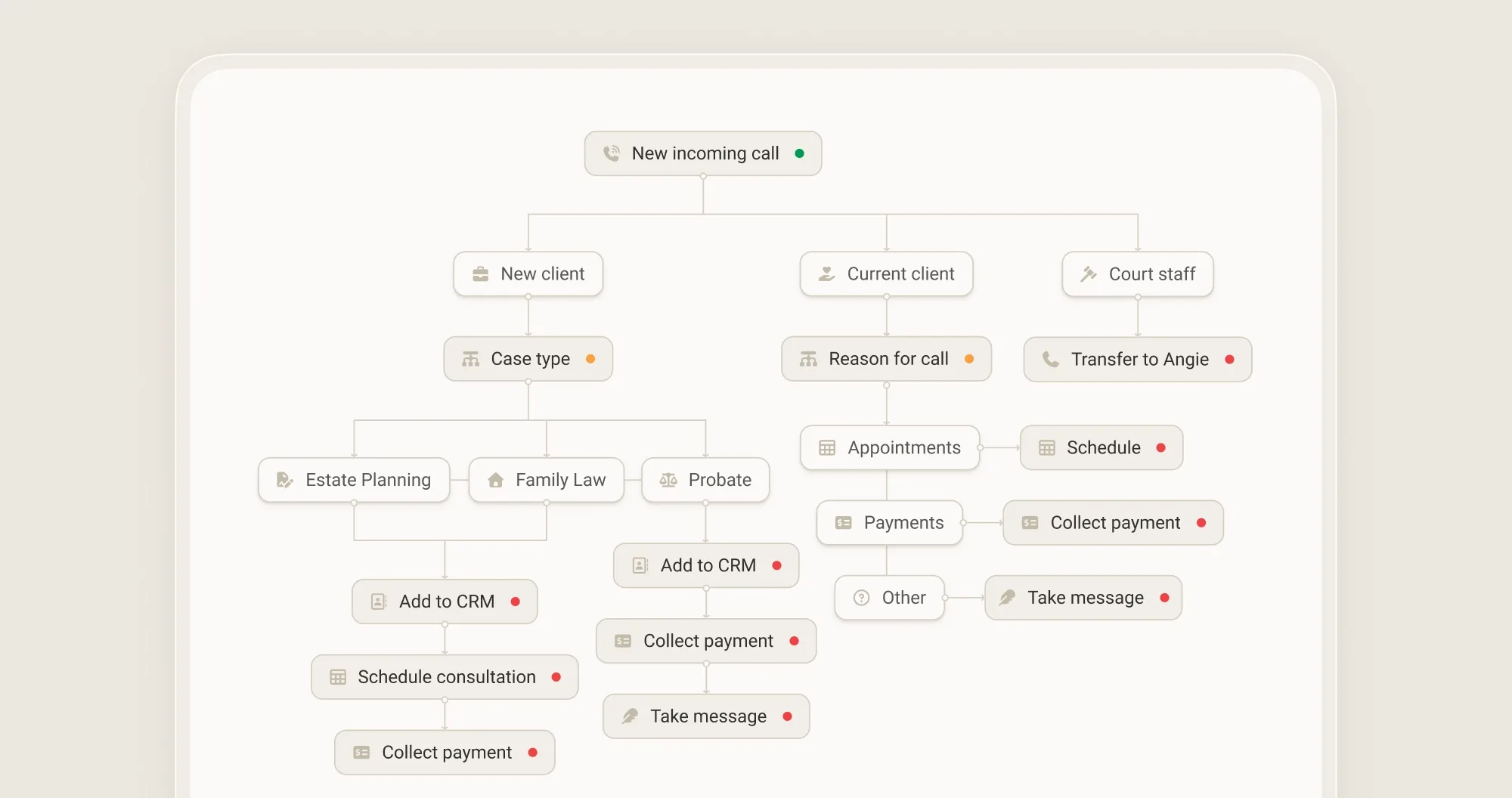
Imagine a small law firm that handles family law, probate, and estate planning.
The firm might want its answering service to follow this general logic:
Step 1: Identify the caller: new prospective client, existing client, opposing counsel, court personnel, or other.
Step 2: Identify the purpose. If it’s a prospective client, is it a divorce, custody case, probate, estate planning, or something else?
Step 3: Apply the appropriate workflow: A divorce prospect might receive a full intake and appointment scheduling, while a custody case might receive a different set of questions and a message-taking process. Opposing counsel may receive immediate transfer instructions, while an existing client is routed based on the nature of their request.
Step 4: Account for availability: If the appropriate person or designated backup is available, transfer the call. If they aren’t, follow the firm’s message or callback procedure.
Step 5: Document the interaction: Thoroughly collect the information the law firm needs and make sure it gets where it needs to go.
That’s a lot of logic, and it’s only one example.
The possibilities are extensive because every law firm operates differently. That’s why having an expert designing and managing your system matters.
Back Office Betties’ Systems Adapt to Your Needs
Your job is practicing law, not maintaining a flowchart.
You shouldn’t have to spend valuable time figuring out which conditional rule needs to change because your firm’s consultation process changed.
With Back Office Betties, you can simply tell your Account Architect: “We’ve changed how we handle new inquiries in custody cases. Here’s what we want Betties to do now.”
We’ll translate that change into the appropriate call handling logic and update your account within 24 business hours.
Law firms change and grow, attorneys add practice areas, and intake requirements change. Back Office Betties ensures your call handling process syncs with those changes seamlessly.
What Makes Back Office Betties Complex Legal Call Handling Different?
If you’re looking for a legal answering service that can follow complex intake scripts without messing them up, the important question isn’t just whether a provider offers customizable scripts.
Ask how the provider actually manages that customization.
Back Office Betties vs. Typical Answering Services
| Legal Intake Need | Back Office Betties | Typical Answering Service |
|---|---|---|
| Varied Intake for Different Practice Areas | Different case types have their own intake questions, qualification criteria, and next steps. | One primary intake script may be used across multiple types of prospective clients. |
| Complex Intake Logic | Account Architects build, manage, and refine intake logic based on how the firm operates. | The firm may need to work within a predefined script or manage changes manually through a self-service system. |
| Different Types of Prospective Clients | A divorce prospect, criminal defense prospect, or family law prospect can follow a different process. | Callers may follow essentially the same intake process regardless of the type of matter. |
| Conditional Instructions | Conditional logic guides the legal intake specialist based on the caller’s answers and circumstances. | More complicated processes may be difficult to represent within a standard script. |
| Time-Based Intake | Intake processes can change based on business hours, after-hours requirements, or other firm-specific conditions. | Intake instructions may be consistent regardless of when a prospect calls. |
| Making Changes to Intake Logic | Clients can explain desired changes in plain language, and Account Architects handle the technical implementation. | Attorneys or staff may be expected to manage scripts or settings themselves through a dashboard. |
The difference isn’t having a customizable script. It’s having a legal intake process that can be customized, managed, and executed by people who understand how the process needs to work in a real conversation.
Explore Complex-Call Handling Expertise
The best answering service for a law firm isn’t necessarily the one with the longest script or the fanciest dashboard.
It’s the one that can take the way your firm operates and turn it into a process that your outsourced answering team can execute accurately, efficiently, and naturally.
Schedule a discovery call today to see how Back Office Betties can support complex legal intake and call routing at your firm.
You bring the rules. We’ll build the logic. Your callers get an experienced, U.S.-based receptionist who knows what to do.
Frequently Asked Questions
Can Back Office Betties legal answering service customize intake scripts for different types of cases?
Yes. Back Office Betties legal answering service can customize legal intake processes based on the type of legal matter, the information your firm needs to collect, and the appropriate next step for the prospective client. This allows a legal intake specialist to follow the process appropriate for each prospective client rather than use the same script for every caller.
Do I have to manage my law firm’s legal intake scripts myself?
No. Back Office Betties clients can explain their desired intake process in plain language rather than managing dashboards or complicated routing technology themselves. Account Architects handle the technical setup, and clients can review their current call logic and work through changes with Back Office Betties. This allows your firm to define how legal intake should work without having to maintain the underlying system yourself.
How does Back Office Betties keep customized intake calls from sounding robotic?
Customization doesn’t mean forcing every prospective client through a long list of scripted questions. Back Office Betties designs intake processes with the receptionist’s actual conversation in mind, using customized logic to determine which questions are relevant and what should happen next. The goal is to collect the information the law firm needs while keeping the conversation natural and avoiding unnecessary questions.